- Published
US President Donald Trump says he has reached an agreement with Russian President Vladimir Putin allowing Moscow to "immediately release" diesel into the global market.
Trump said Putin had agreed to release 300,000 tonnes of diesel immediately, followed by 500,000 tonnes in November and another million after that.
"Diesel Prices for Americans and, indeed, the World, will be COMING DOWN, IN RECORD NUMBERS, AND FAST!" Trump wrote on his Truth Social platform.
An envoy to Putin welcomed the deal, but Ukrainian President Volodymyr Zelensky said any easing of sanctions on Russia played into Moscow's hands and would prolong the war.
Friday's announcement is the latest effort from Trump to lower fuel prices in the US, as he has spent months grappling with the political consequences of the Iran war, which began in February, and its impact on global energy prices.
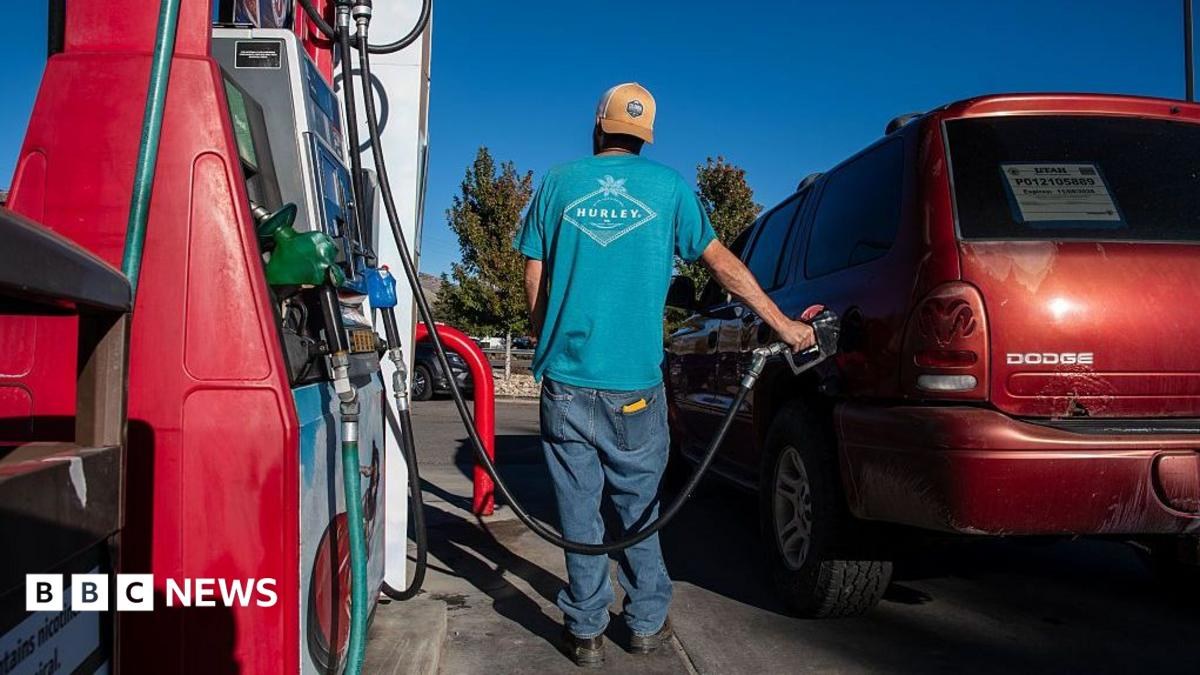
That conflict has sent the cost of petrol and, in particular diesel, skyrocketing in America in recent months, which has soured his standing with the public who have been stung by the higher pump prices and knock-on effects that led to across-the board inflation.
The average diesel price in the US is currently $6.28 (£4.74) a gallon, according to the AAA, down from the record high of $6.53 recorded at the end of September.
Shortly after Trump's announcement, the US Treasury formally issued a temporary license allowing Russian diesel into the market.
An envoy for Putin, Kirill Dmitriev, welcomed the deal on social media, saying: "Russia-US co-operation on diesel and energy will benefit the world."
But Zelensky hit out at the deal, saying "gifts to Putin will not work for peace" and that Russia would repay the diesel with "further terror".
"Allowing Russia to sell petroleum products is an investment in a war that must be ended, not prolonged," he wrote on social media.
Russia has this year experienced two waves of severe fuel shortages across the country as a result of Ukrainian drone strikes on Russian oil refineries.
According to the International Energy Agency, its diesel production is estimated to have fallen by nearly 30%.
Trump has expressed his displeasure over those attacks, blaming them for rising fuel prices.
But on Friday Zelensky defended the strikes, saying there were in response to "Russia's years-long campaign of terror against Ukraine's energy sector".
"Ukraine will not set Russian oil refineries on fire if Russia does not destroy our energy infrastructure," he said.
-
Trump wants to reduce the cost of fuel as the midterms loom - will it work?
- Published1 hour ago
Trump's Truth Social posts often provide incomplete information and the details of exactly how Russia is supplying this fuel to the global market, and what they might get for in return is unclear.
But the announced deal represents a remarkable about-face, as the US Congress recently enacted legislation - signed by the president - to authorise new American sanctions and tariffs on nations that import Russian oil and gas.
The agreement with Russia also opens Trump up to criticism from European allies and pro-Ukraine politicians in the US, that the American president is now helping to fund Moscow's war machine.
What impact the deal with Russia will have on fuel prices also remains unclear. The global benchmark for crude oil, Brent, remains above $103 a barrel. Before the war with Iran, Brent crude was trading at about $73 a barrel.
The BBC has contacted the White House for comment on what reimbursement the US is providing Russia in return for the release of diesel.
With the looming US midterm congressional elections - which will determine if Republicans maintain control of Congress - Trump has been searching for ways to ease his Republican party's political pain.
Earlier this week, he said he was "thinking about" suspending the federal tax on gasoline, and also announced that he would allow so-called red dye diesel to be used on US highways without facing federal tax.
Trump has also successfully pressured G7 nations into releasing 100 million barrels of oil and diesel from stockpiles to help ease supply concerns, and previously supported calls for a ban on diesel exports from the US.