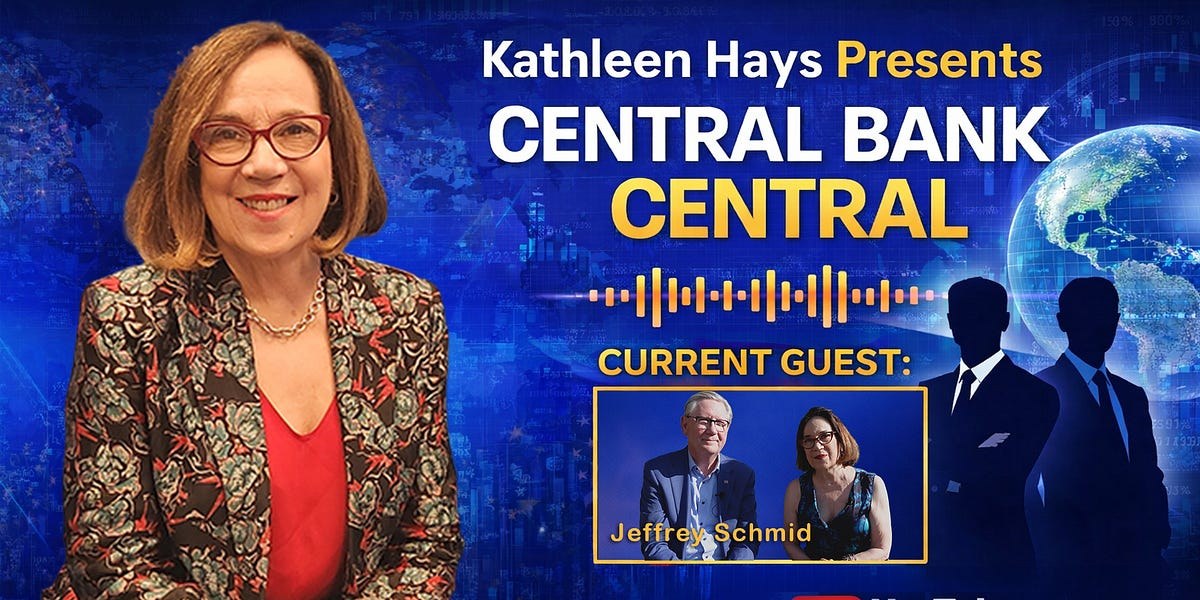
Jeff Schmid is a very busy man who is getting ready as President of the Federal Reserve Bank of Kansas City to kick off the bank’s annual policy symposium in Jackson Hole. And yet he has taken time to to sit down and talk to Central Bank Central at what is arguably the most important Federal Reserve conference held each year.
In addition, as president of the K.C. Fed, Jeff is in charge of welcoming the new Fed Chair, Kevin Warsh, who takes the podium to deliver his long awaited speech tomorrow morning.
For President Schmid - and everyone at the Fed - the battle to bring down inflation has been the top priority. He dissented at policy meetings twice in 2025 opposing rate cuts. He became known as a Fed hawk. Now, in our conversation at the Jackson Lake Lodge, he lays out the many factors he sees that will determine if and when he votes for a rate hike in the final months of 2026.
Spoiler alert: Jeff says at meetings with community and business people in his district when he asks for a show of hands, the vast majority responds indicating policy is still not restrictive - which he says points to policy that’s still accommodative.
So dive in hear what this Fed president is watching and supports come September and future meetings this year.
————————————————————————————————————
KC Fed Conference in Jackson Hole- 50 Year mark coming… Well, welcome. Never gets old, does it? Kathleen - This is amazing. 49 years. The Kansas City Fed’s been doing this 50 years next year I know. So that’s going to be a big one. Jeffrey - It’s going to be a party. Oh yeah.
2% remains the inflation mandate; we are not there yet 00:01:06:15
Well, so we had some prints today. And you know, it just didn’t inspire me that we’re trending in the right direction. I’ve been pretty public and vocal about where I think rates are relative to inflation. I think it’s something, you know, I’ve said this publicly, it’s an economic thief. It’s a mandate of ours to get it to 2%.
The road to target may be long but the last part may be the hardest 00:01:26:06 -
I appreciate Chairman Warsh coming in and kind of reconfirming this is what the Fed does. And yeah we have work to do. And so and but I will say this that what I’ve learned as a Fed president and a member of the FOMC, perhaps the last mile - that being the last 50 to 100 basis points of inflation - may be the hardest part of the of the journey.
Right? So because what you don’t want is overshoot. So I think there’s a lot of thoughtful data and analytics and discussion. The debate at the table that we talk about and, you know, trying to get it right because you want-- you don’t want to-- overshoot that number. You have a great economy. It seems to be performing well.
The labor force seems to be in good alignment and in a good place. But we got work to do.
My informal surveys show people do not find policy restrictive 00:02:34:18
So here again, I’ve been pretty public about this too. And we’ve done tons of round tables in the district in the last year. And I usually end these roundtables with kind of a show of hands. And I would say that by and large, most, most people, most community leaders, business leaders don’t believe that the policy rates restrictive.
If not restrictive then accommodative! A need for action 00:02:56:14
And so that would beg the question if it’s not restrictive, it’s accommodative. And that means, you know, do we need to take action to firm up the lower end of the of the yield curve.
What will it take to make the move on rates? 00:03:09:20
Okay. So it’s a great question. And it has so many different layers. It’s kind of like an onion. So the outside of the onion today is being dominated by energy prices right. The headline the issues in the Middle East. But there’s so many interesting things going on from a demand side inside the onion. You know, how much is the technology data centers AI build out driving GDP, what commodity prices are affected by that demand? And so what you got to do is if you’re going to raise the policy rate, 1 or 2 things that you hope happens. One is it affects some demand. So inflation and prices start to go back down to the 2% level. And with that, are you changing behaviors with those policy moves. People will say, well what does a quarter increase really do?
Every 25 bp change matters; it sets a new stage 00:04:01:21
Well it’s a behavioral thing. Capital and credit movers take that and they put it into their models. And it does change the nature of capital and credit.
I don’t know. You know, here again, I’m in the same camp as the other 18 on the FOMC is like, it’s what is the data telling me? And what is it trending here again? That last mile is what everybody is debating. Now. I would probably be very consistent with some of the narrative that came out of the last FOMC meeting on the dissent side.
<Some> believe that policy rates should have been increased if I’m going to be consistent with my dissents in 2025, and then I would probably say it the policy rate we’d need to consider an increase.
The dual mandate allows a shift to support the inflation side of it 00:05:13:06
So we have a dual mandate as you know. I mean I think labor is in a good place, right. And so if we believe labor is in a good place, then we can focus on the inflation rate and we can focus on the demand side of what’s creating it. So so we’ll be I think we’ll be talking about that.
There are supply effect but also pockets of excess demand 00:05:28:23
And but you make a good point. The nature of what’s driving the economy. There are pockets. You know, I talked about some folk with some folks this week. The cattle business is booming. But, the poultry business is soft, so you have to look at elements inside what’s driving the economy. And you don’t want to do any unnecessary harm.
The yield curve seem to be in a good place 00:05:50:17
But frankly, the yield curve looks like it’s in a good place. And I think we have a room.
An interesting, dynamic, conference ahead 00:06:11:21
So you’ll be very interested in this subject matter <at the symposium> , I think, because the nature of payments, I mean, we move $5 to $10 trillion of payments a day right through the system. What’s happening from an innovative standpoint and a technological standpoint is really going to be transformational and somewhat disruptive. So I’m excited you’re here.
Jeffrey SchmidJeff Schmid is president and chief executive officer of the Federal Reserve Bank of Kansas City. He represents the Tenth Federal Reserve District on the Federal Open Market Committee, which sets monetary policy for the United States.
Schmid leads a workforce of nearly 2,000 professionals engaged in the work of the central bank, including monitoring economic conditions, supervising banking institutions, and providing financial services to banks and the United States government. Through offices in Kansas City, Denver, Oklahoma City and Omaha, the Bank serves a seven-state region that includes western Missouri, Kansas, Nebraska, Oklahoma, Colorado, Wyoming, and northern New Mexico. As Bank president, he hosts the annual Jackson Hole Economic Policy Symposium, bringing together international central bankers, academics, and policymakers to discuss economic and financial policy issues.
Among the Bank’s accomplishments under his leadership is the implementation of a five-year strategy aligning the Bank’s efforts in serving the Tenth District. It is focused on deepening and expanding talent investments, leveraging expertise in technology and artificial intelligence, maximizing regional connections and communications, and advancing value-added analytics.
Schmid has more than 40 years of experience in banking and bank supervision. Prior to joining the Kansas City Fed in August 2023, he served as the president and CEO of the Southwestern Graduate School of Banking Foundation at Southern Methodist University’s Cox School of Business, which focuses on bank leadership and strategic planning for community banks.
Among his banking experience, he led Mutual of Omaha’s entry into banking sector, serving as chairman and CEO of Mutual of Omaha Bank which served depositors and borrowers nationwide.
Jeff is a graduate of both the University of Nebraska-Lincoln and the Southwestern Graduate School of Banking at SMU. He is a native of Nebraska.
Explore his latest speeches, outreach and more on the Office of the President page.