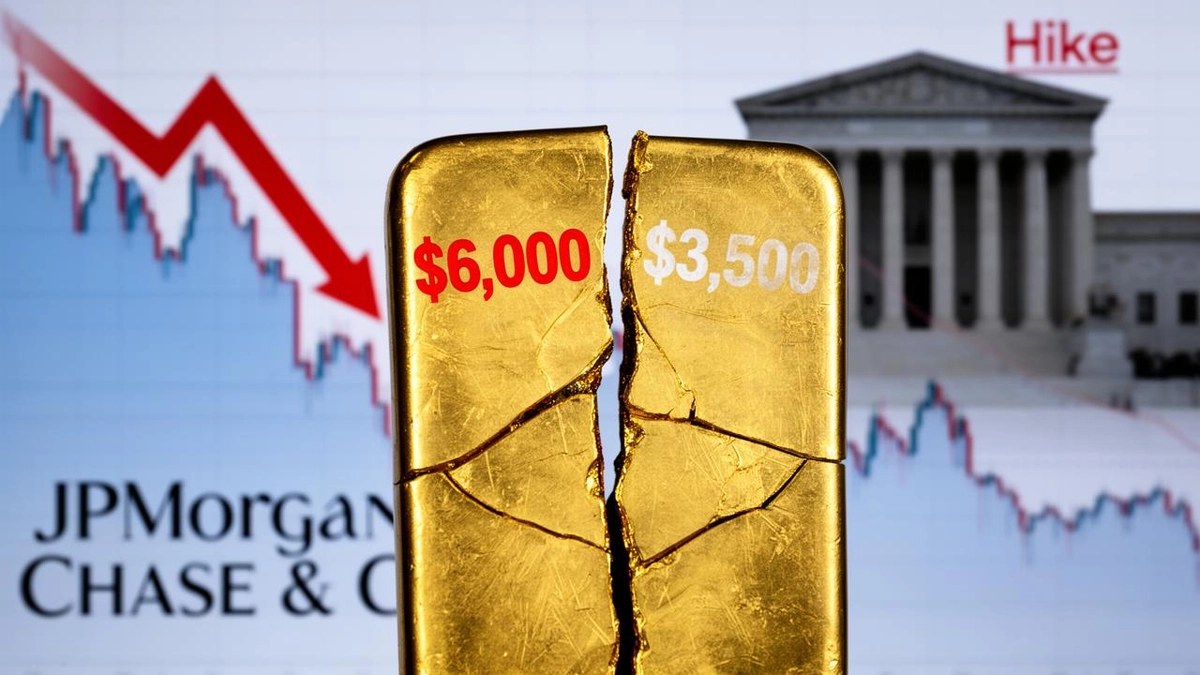
International gold prices have just suffered their worst monthly drop in nearly 18 years, and Wall Street titan JPMorgan has dropped a bombshell, slashing its gold price forecasts for the second half of the year by 20% to 25%. This effectively declares an end to the "buy-without-thinking" rally previously driven by risk-aversion sentiment and aggressive central bank buying. Although gold prices saw a technical rebound following the release of extremely weak U.S. employment data, JPMorgan explicitly warns that if summer economic data forces the Federal Reserve to hike interest rates prematurely, gold prices could break below the $4,000 per ounce mark (approximately NT$130,000), potentially testing the $3,500 to $3,600 range (approximately NT$110,000).
According to JPMorgan's latest precious metals research report, the bank has lowered its average gold price forecast for the third quarter of 2026 to $4,300 per ounce (approximately NT$140,000), with the fourth-quarter forecast also cut to $4,500 (approximately NT$140,000). Compared to its aggressive prediction on June 9, which saw gold reaching $6,000 by year-end (approximately NT$190,000), the target price has shrunk dramatically in less than a month, drawing significant market attention.
Pricing Power Returns to Interest Rates: Gold Re-couples with Fed Policy
The JPMorgan report highlights a critical market pivot: as buying from global central banks, Asian physical demand, and retail "currency debasement trade" enthusiasm all cool down, interest-rate-sensitive gold ETF flows have reclaimed marginal pricing power over the gold price. This means the negative correlation between gold and U.S. real interest rates, dormant for several years, is making a strong comeback, once again tethering gold price movements to the Federal Reserve's next steps.
Looking back at the evolution of gold's pricing logic, before 2022, gold prices had a highly negative correlation with U.S. real interest rates, a simple and stable logic that dominated the market for over a decade. After 2022, aggressive Fed rate hikes led to massive outflows from ETF holdings, but explosive growth in global central bank gold demand not only filled the funding gap but also allowed gold to temporarily decouple from real interest rates. However, since March 2026, the landscape has reversed again. The U.S.-Iran conflict triggered an initial deleveraging effect, and the new Federal Reserve Chair, Kevin Warsh, sent strong hawkish signals upon taking office, causing other demand segments to collectively stall.
With demand broadly dormant, interest-rate-sensitive ETF flows have become the only active marginal force in the market. Data shows that since the end of February, global gold ETFs have seen net outflows of approximately 128 tonnes (a decline of about 3%), which roughly aligns with the historical relationship corresponding to the roughly 50-basis-point increase in U.S. 10-year real interest rates.
More notably, gold's sensitivity to real interest rates is even more pronounced than before 2022: for every 1-basis-point increase in real rates, gold prices fall by about $20 (approximately NT$600), with the cumulative decline already exceeding 20%. JPMorgan's analysis suggests this "excess sensitivity" precisely reflects the current extremely weak state of other demand segments. The absence of this demand not only amplifies the impact of real interest rates but also significantly compresses the original support base for gold prices.
Market Pricing Runs Ahead of Forecasts: ETF Flow Direction Flips
JPMorgan's current baseline forecast is that the Fed will remain on hold this year, with the first rate hike delayed until the third quarter of 2027. However, market pricing has already run ahead of these forecasts—the OIS forward market is now almost fully pricing in the probability of "one rate hike within the year" and expects a cumulative tightening of nearly 40 basis points by April 2027. This timeline and the magnitude of hikes are both earlier and more aggressive than JPMorgan's baseline scenario.
Based on the latest real interest rate forecasts, JPMorgan has simultaneously revised its 2026 global gold ETF flow forecast sharply downward, from a previously estimated net inflow of about 400 tonnes to a net outflow of roughly 50 tonnes (as of June 26, year-to-date flows were still a net inflow of about 19 tonnes). This significant adjustment once again confirms that the logic of the gold market is undergoing a notable structural reversion.
Long-Term Bullish View Intact: 2027 Quarterly Recovery Path Revealed
Despite a more conservative short-term outlook, JPMorgan has not turned outright bearish on gold. The bank maintains its long-term bullish stance, emphasizing that the "currency debasement trade" is merely temporarily obscured by the hawkish monetary policy narrative, not extinguished. Two major structural forces supporting the long-term bull case remain: First, central bank gold purchases resumed net buying in April and May, and China's gold import data remains robust, suggesting that strategic reserves at the official level are still quietly accumulating. Second, once India's import restrictions are lifted, it will trigger a massive release of pent-up compensatory demand.
JPMorgan expects these structural forces to reassert themselves in 2027, driving gold prices higher quarter by quarter: $4,600 in Q1 (approximately NT$150,000), $4,700 in Q2 (approximately NT$150,000), $4,800 in Q3 (approximately NT$150,000), and $5,000 in Q4 (approximately NT$160,000), with the full-year average price potentially reaching $4,775 (approximately NT$150,000). However, the report specifically stresses that for gold to resume its upward trajectory, a prerequisite is a dovish pivot by the Federal Reserve, a condition that has not yet materialized.
Another potential risk stems from unexpected U.S. dollar strength. JPMorgan's foreign exchange strategists point out that if artificial intelligence (AI) is more widely used as a geopolitical bargaining chip, the growth gap between the U.S. and other economies will widen further, driving the dollar higher and exerting additional pressure on dollar-denominated gold.
Institutional Views Diverge: State Street Sees $5,500
While JPMorgan slashes its target price, other Wall Street institutions hold differing views. U.S.-based State Street estimates a 70% probability that gold prices will rise to between $4,750 and $5,500 per ounce (approximately NT$150,000 to NT$180,000) over the next 6 to 9 months, but also sees a 25% chance of oscillation within the $4,000 to $4,750 range (approximately NT$130,000 to NT$150,000). State Street believes gold has strong support in the $3,750 to $4,000 zone (approximately NT$120,000 to NT$130,000), but the probability of a bullish scenario reaching $5,500 to $6,250 (approximately NT$180,000 to NT$200,000) is only 5%, lower than expectations from January and February of this year.
The World Gold Council (WGC), in its "Gold Mid-Year Outlook 2026" report released in July, adopted a relatively neutral stance. The council predicts that gold prices in the second half of 2026 may fluctuate around $4,100 per ounce (approximately NT$130,000), with a volatility range of about ±5% (i.e., a $3,900 to $4,300 range). However, if economic or geopolitical risks worsen, gold prices could resume an upward trend, targeting $4,500 (approximately NT$140,000), with only strong and clear signals capable of sustaining a rally to $5,000 (approximately NT$160,000).
The World Gold Council identifies three catalysts that could drive the next leg up for gold: worsening economic or geopolitical conditions, a reversal in interest rate expectations, and increased participation from long-term investors. The report indicates that a 100-point monthly increase in the Global Gold Risk Index (GPR) typically pushes gold prices up by 2.5%.
Gold/Silver Ratio Normalizes: Divergent Paths for Silver, Platinum, and Palladium
For the broader precious metals complex, JPMorgan also provided its latest forecasts. For silver, solar panel demand is expected to decline by about 30% year-on-year in 2026 (equivalent to over 60 million ounces), bringing the silver market towards balance after five consecutive years of supply deficits, with a potential shift to a small surplus in 2027. JPMorgan expects the gold/silver ratio to converge towards 70 to 75, with silver averaging around $70.6 per ounce in 2026 (approximately NT$2,300) and retreating further to $63.9 in 2027 (approximately NT$2,100).
For platinum, currently around $1,600 per ounce (approximately NT$51,000), prices are already near the "fundamental incentive price" required for South African miners to maintain necessary investment. JPMorgan expects platinum to rebound in tandem with gold's stabilization, rising to $1,800 by year-end (approximately NT$57,000) and further to $1,950 by the end of 2027 (approximately NT$62,000). Palladium, on the other hand, continues to see demand eroded by electric vehicle adoption. While it is expected to recover to $1,350 by year-end (approximately NT$43,000), its full-year average price for 2027 will likely remain capped around $1,300 (approximately NT$42,000).
Long-Short Battle Intensifies: Investors Focus on Fed Moves
As of July 3, spot gold prices settled up about 1.2% at $4,170.30 per ounce (approximately NT$130,000), having touched an intraday high not seen since June 23, with a weekly gain exceeding 2%. The key driver for this rebound was the U.S. June nonfarm payrolls report, which showed an increase of only 57,000 jobs, far below market expectations, further weakening expectations for the Fed to maintain a tight policy stance. According to the CME FedWatch Tool, the market-implied probability of a 25-basis-point rate hike in September has fallen to about 53.5%, a significant pullback from earlier levels.
However, the interest rate environment is still viewed as the primary headwind for gold prices. Since gold itself yields no interest, a high-rate environment tends to shift funds towards fixed-income assets, thereby suppressing precious metal performance. Industry insiders point out that for gold bulls to regain a trading advantage, at least one of three factors needs to improve: a decline in real yields, a weaker U.S. dollar, or a clearer fading of hawkish Fed expectations. Without these conditions, rebounds are likely to be sold into by global institutional funds on strength, and gold may spend more time consolidating below its previous highs.
Looking back at 2025, both gold and silver posted historic rallies, surging 66% and 135% for the full year, respectively. While the momentum initially carried into early 2026, the market subsequently turned highly volatile. Gold has cumulatively fallen about 3% year-to-date, and its status as a traditional safe-haven asset began to be questioned by the market, especially after the U.S.-Iran war erupted in February. As major institutions like JPMorgan adjust their forecasts, the gold market is entering a phase of more intense long-short confrontation. The Federal Reserve's future policy path will be the key variable determining the medium-term direction of gold prices.
Once added, BigGo Finance appears first in Google Search Top Stories, so you get the broadest, most up-to-the-minute, and most comprehensive global financial news first.